
How Is the Australian Prime Minister’s Evacuation Related to Shen Yun—and Is This a National Security Threat?
When I saw Shen Yun for the first time in 2012, that single evening gave me more insight into that culture and history than I ever would have thought possible.
Shen Yun is a performing arts company based in a regional area of New York State in the U.S.A. They showcase traditional Chinese history through the art forms of orchestral music and world-class dance, incorporating modern technology with the use of a digital backdrop. The overall effect transports you to historical periods in China where myths and legends unfold.
Shen Yun has eight troupes that tour the world with new stories and elements each year. Their stated mission is “to revive authentic Chinese culture.”
So, how is the Australian Prime Minister’s evacuation related to Shen Yun?
The Australian leg of the 2026 Shen Yun tour was about to begin when news broke on 24 February that Anthony Albanese had been briefly evacuated from the Prime Minister’s residence due to a threat to his life.
The threat, written in Chinese, had reportedly been received by the Australian presenters of Shen Yun Performing Arts and demanded that the show not go on, as per reporting by The Epoch Times, which was the first news media to break the story.
Similar threats have also occurred in other countries.
Why Make the Threat against Shen Yun in Australia?
Why would someone use violent coercion to attempt to prevent an artistic performance that showcases a country’s traditional history? One possible motive would be to protect the reputation of the Chinese Communist Party (CCP).
The CCP has been the ruling party in China since 1949. The Cultural Revolution (1966–1976) is the most famous of several actions taken by the CCP, which systematically attacked traditional culture in an effort to reshape that society along ideological lines.
Shen Yun’s performances explicitly revive elements of that pre-Communist heritage. In doing so, they present a version of Chinese civilisation that is culturally rich, spiritually rooted, and historically continuous—and not centred on the Party.
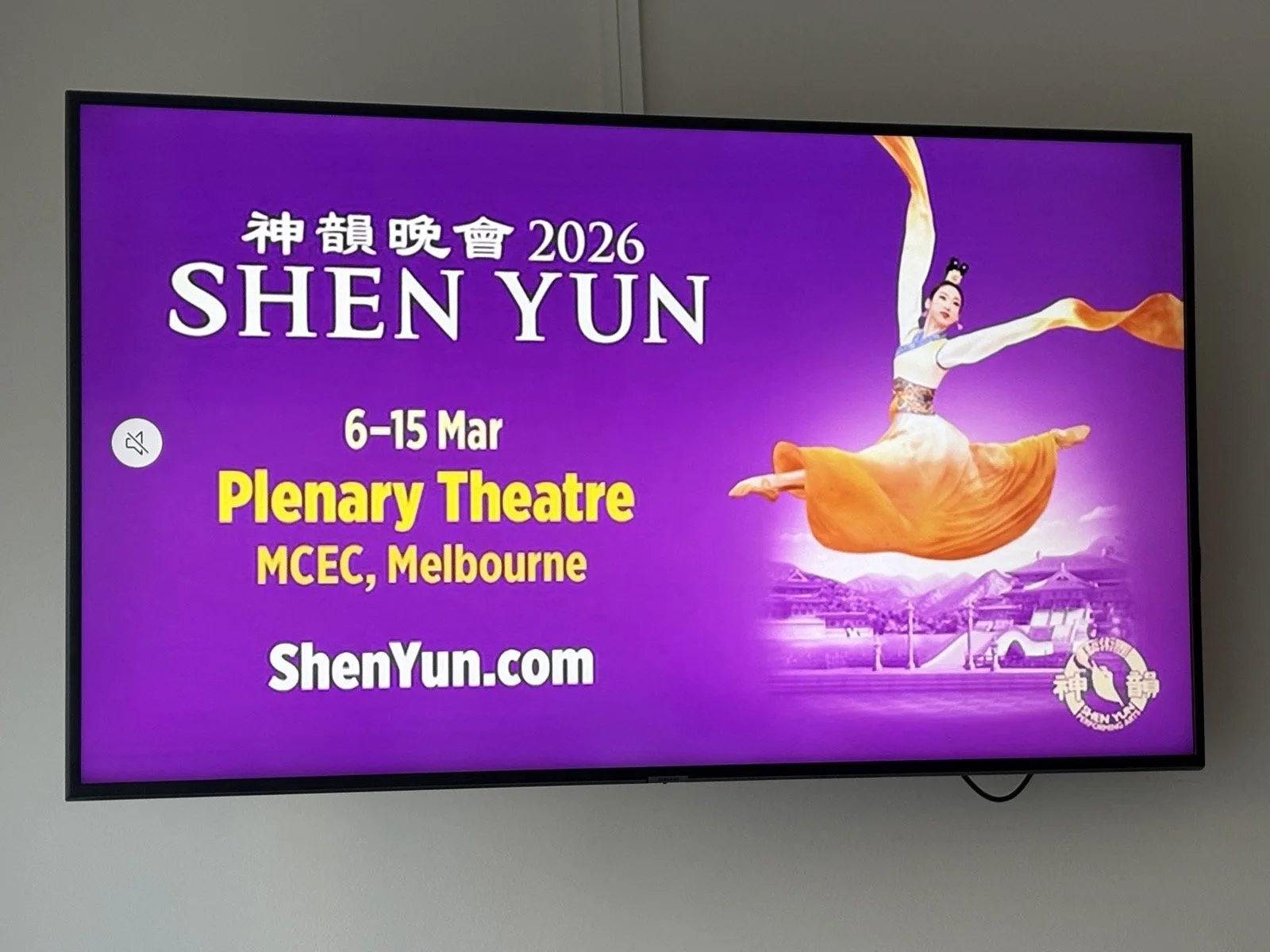
2026 Shen Yun poster in Melbourne
In many Asian societies, the concept of “saving face” carries weight. Avoiding embarrassment, humiliation, or getting into trouble seems to be built into human nature. You realise you’ve made an error and are embarrassed. If it is possible, no matter how good a person you think you are, you will feel a compulsion to cover up what you did to avoid the embarrassment. Admit it! Every child does it, and I strongly suspect every adult still does it on occasion as well.
In the Chinese political context, this compulsion is magnified. Strongly instilled national sentiment means that personal reputation is seen as dependent on the country’s reputation. Now add to that the fact that the CCP has spent over seven decades convincing Chinese school children that the CCP is China, and China is the CCP.
Criticism of the CCP can be perceived by some as an attack on China itself. Anything that embarrasses or criminally implicates the CCP could trigger a strong defensive response in some individuals.
If that is the lens through which Shen Yun is viewed, then the hostility begins to make more sense—even if it remains entirely unjustifiable.
Who Made the Threat?
At this stage, the public does not know who made the threat. But two broad explanations present themselves.
First, the threat could have originated from someone operating within, or in alignment with, CCP structures. Authoritarian systems do not always require formal directives for intimidation to occur. Sometimes individuals act pre-emptively, assuming they are advancing the interests of the state.
Second, the threat may have come from a private individual influenced by the political culture surrounding the CCP. When a governing party successfully equates itself with the nation, criticism of one can feel like betrayal of the other. In that environment, extreme reactions can be framed internally as patriotic duty.
Without concrete evidence, it would be irresponsible to draw firm conclusions. What is clear, however, is that the threat reflects a broader climate in which artistic and political expression are seen by some as existential challenges rather than legitimate discourse.
Is This a National Security Threat to Australia?
On its own, a single threat might be dismissed as the act of a lone individual. But context matters.
In November 2025, a documentary titled State Organs, which alleges human rights abuses in the form of forced organ harvesting by the CCP, was scheduled to be shown at a church in Campbelltown, Sydney. Event organisers reportedly received two separate bomb threats, and the screening event at that venue was cancelled.
In this case, intimidation achieved its immediate aim.
When threats succeed—even once—they create a precedent. They test whether fear can influence public events. If there are no visible consequences, others may conclude that such tactics are effective.
This is where the issue moves beyond Shen Yun.
If individuals—whether CCP-linked, sympathetic, or ideologically motivated—are willing to use threats to influence what Australians can watch, discuss or criticise, that touches on national sovereignty. It becomes a question of transnational repression, foreign interference and coercion, not merely cultural disagreement.
Australia is a democratic society. Artistic performance, documentaries, and political critique are part of normal civic life. If intimidation begins shaping those activities, even indirectly, it raises serious questions about resilience and response.
Fear used to control cultural expression
I do not claim to know who made the threat against the Prime Minister. Nor do I claim that every such incident represents coordinated foreign action.
But I do believe this: when political sensitivities from abroad spill into Australian public life in the form of threats—particularly threats serious enough to prompt the evacuation of a sitting Prime Minister—it cannot be treated lightly.
Whether the source was an organised actor or an individual acting out of ideological conviction, the underlying issue is the same. Someone believed that fear was a legitimate tool to control cultural expression in Australia.
That is not simply a matter of hurt feelings or political disagreement.
It is a test.
A test of whether intimidation works.
A test of whether democratic societies protect open discourse.
And a test of how seriously we take attempts—however subtle or indirect—to pressure or silence that discourse.
The identity of the person who made the threat will matter. But how Australia responds may matter even more.
I, for one, have gone so far as to buy plane tickets in order to attend a Shen Yun performance in March, and I am looking forward to it.
~~
We hope you enjoyed reading this post.
‘Learn Falun Gong—Australia’ is a website run by Australian Falun Dafa volunteers for the benefit of the general public. Falun Dafa is always taught free of charge.
Views expressed in this article represent the author’s own opinions or understandings.