
April 25: A Peaceful Falun Gong Appeal That Still Raises Hard Questions
April 25 is a date that sits quietly in most calendars, but for practitioners of Falun Gong it carries lasting weight. It marks a moment that began with calm, orderly petitioning in Beijing and ended up shaping one of the longest-running human rights controversies in modern China.
It is also a date that invites reflection outside China. In places like Australia, where public assembly and religious practice are generally protected and taken for granted, the events of that day raise uncomfortable but important questions about how far those freedoms extend in other parts of the world, and what happens when peaceful groups fall outside what a state considers acceptable.
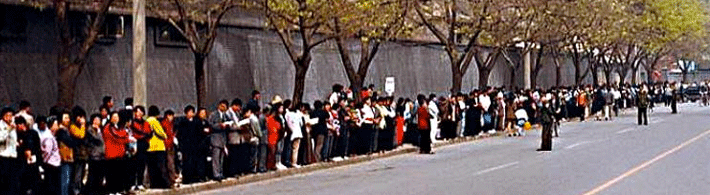
On April 25, 1999, some 10,000 Falun Gong practitioners spontaneously gathered at the central appeals office in Beijing, as they had been instructed by Tianjin officials. (photo credit: minghui.org)
The Falun Dafa gathering in Beijing
On April 25, 1999, thousands of Falun Gong practitioners travelled to Beijing spontaneously and independently. Estimates commonly place the number at around 10,000. They gathered near Zhongnanhai, the compound associated with China’s central leadership.
The atmosphere, by multiple accounts from participants and observers at the time, was not loud or chaotic. There were no chants or banners. People stood quietly. They waited in lines. They spoke calmly when they were approached. The image that emerges is not one of confrontation, but of restraint.
The message they brought was simple in structure, even if significant in implication. They asked for three things: the release of practitioners who had been detained in Tianjin following earlier incidents, the ability to continue practising without interference, and formal recognition that would allow them to exist openly within the legal system.
There was no attempt to force entry, no disruption of public order, and no escalation into violence. By the end of the day, people dispersed peacefully, with many Falun Gong practitioners reportedly picking up rubbish off the streets.
What makes the event stand out is not only what was said, but how it was said. Large-scale public appeals often carry tension. This one, at least outwardly, did not.
The shift that followed
Within months, the situation changed dramatically.
The Chinese Communist Party (CCP) initiated a nationwide campaign against Falun Gong. What had been a widespread spiritual practice, reportedly involving millions of people across China in the 1990s, was reclassified as a threat that needed to be eliminated from public life.
Detentions began on a large scale. Practitioners were sent to detention centres, labour camps, and other facilities. Over time, reports from human rights organisations, researchers, and former detainees described patterns of coercion and abuse. These accounts include allegations of forced ideological conversion, physical mistreatment, and long-term imprisonment without due process.
One of the most serious allegations to emerge over time involves claims of forced organ harvesting from detained practitioners. Investigations by independent researchers and tribunals have concluded that such abuses have occurred, though the full scope remains difficult to determine due to restricted access to detention facilities and limited transparency within China.
Falun Gong as a practice
Falun Gong, also known as Falun Dafa, is built around a set of meditation exercises and moral teachings. At its core are three principles: truthfulness, compassion, and tolerance. The practice involves slow, gentle qigong exercises and periods of meditation, alongside a focus on personal conduct and self-improvement.
It is not a political organisation. It does not present itself as a movement seeking power or political representation. In its own framing, it is a spiritual discipline rooted in traditional Chinese culture.
Before 1999, it experienced rapid growth across China among people from different regions and social backgrounds including many top leaders in the CCP. That scale of popularity, combined with its organisational independence from the state, placed it in a complicated position within a system that tends to closely manage large, unsanctioned social groups.
Life after the crackdown of Falun Gong
Despite the pressure placed on practitioners within China, Falun Gong has not disappeared. Instead, it has persisted in different forms, both inside China under significant constraints and outside China in diaspora communities.
In many countries, practitioners continue to gather in public spaces. They hold small vigils, demonstrate the exercises in parks, and distribute information about their experiences. These activities are typically quiet and structured. They do not seek confrontation, and are conducted within local legal frameworks.
What stands out over time is consistency. Whether one agrees with their beliefs or not, the pattern of response from practitioners has remained non-violent. That fact is frequently noted even by those who do not engage with the practice itself.
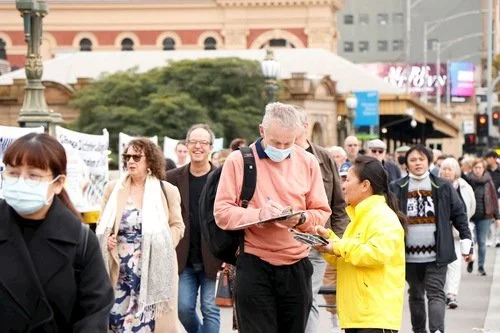
Melbourne Falun Dafa practitioners hold activities to commemorate April 25.
The Australian context
In Australia, April 25 is already a day of national significance, ANZAC Day, dedicated to remembrance of military service and sacrifice. It is one of the most solemn dates in the Australian calendar.
Because of this, Falun Gong practitioners in Australia often approach the date with care. Large public activities are usually avoided. Instead, smaller commemorations may take place on nearby days or in less prominent settings.
This approach reflects an awareness of local culture and public sentiment, and a desire to avoid placing one form of remembrance in competition with another.
At the same time, it highlights a broader reality faced by diaspora communities: balancing respect for the societies they live in with ongoing concern for events in their countries of origin.
Why the events still matter
More than two decades later, April 25 continues to be discussed because it represents more than a single gathering. It sits at the beginning of a much longer story about how a state responds to large, independent belief systems that operate outside formal political structures.
For some observers, it raises questions about proportionality, governance, and the limits of state authority over spiritual life. For others, it is framed through the lens of national security and social stability. These interpretations do not align, and they rarely meet comfortably in the middle.
What is clear is that the consequences of what followed that day have not faded. The experiences of those affected, and the ongoing lack of open access to information within China regarding detention practices, continue to shape international discussion.
Closing reflection after the Appeal
April 25 began as a peaceful appeal. It did not involve confrontation or violence. It was, in form, an attempt at communication.
What followed was a sharp and lasting shift in how that group was treated within China.
For supporters of Falun Gong, the date represents the beginning of an injustice that has continued far too long.
But regardless of where one stands, the basic facts of the day remain difficult to ignore. Thousands gathered peacefully. They left peacefully. And within a short time, the space for that kind of gathering was gone.
The significance of April 25 lies not only in what happened in Beijing that day, but in the years that followed, and in the question it leaves hanging: what becomes of peaceful expression when a state decides it no longer belongs?
~~
Learn Falun Gong—Australia & New Zealand’ is a website run by Australian & New Zealand Falun Dafa volunteers for the benefit of the general public. Falun Dafa is always taught free of charge.
Falun Dafa volunteers are currently holding free online classes where you can learn the exercises from the comfort of your own home. Register for a free Falun Dafa online exercise class hereor for the Falun Dafa 9-Day Lecture Series here.
Views expressed in this article represent the author's own opinions or understandings.