
Why Does the Chinese Communist Party Oppose Falun Gong?
At first glance, Falun Gong and communism might seem to have little to do with one another. One is a spiritual practice centred on meditation and personal moral improvement. The other is a political ideology concerned with power, economics, and the organisation of society.
Yet the Chinese Communist Party (CCP) has spent more than a quarter of a century trying to eradicate Falun Gong. Since former Chinese leader Jiang Zemin launched the persecution in July 1999, the CCP has devoted enormous resources to propaganda campaigns, arrests, imprisonment, forced labour, and other forms of repression in an effort to eliminate the practice.
Many explanations for this focus on politics. Falun Gong grew rapidly during the 1990s and attracted tens of millions of practitioners throughout China. Its popularity rivalled the size of the Communist Party itself, and it operated independently of Party control. These factors undoubtedly contributed to the CCP's decision to suppress it.
However, the conflict runs deeper than politics. At its core lies a clash between two fundamentally different ways of understanding human nature, the causes of human problems, and the path to a better society. Perhaps the clearest difference can be found in how each worldview approaches conflict itself.
The communist Philosophy of Conflict
The idea of “struggle” occupies a central place in communist thought. Karl Marx viewed history as a process driven by conflict between social classes. Communist movements that came later expanded this idea far beyond economics, transforming struggle into a broader political and social principle. Mao Zedong went so far as to celebrate struggle itself, famously declaring that there was "endless joy" in struggling against heaven, earth, and fellow human beings. Conflict was no longer viewed merely as an unfortunate reality to be managed or overcome, but as a necessary and even desirable force capable of remoulding society and shaping the course of history.
Throughout the twentieth century, communist regimes repeatedly encouraged people to identify enemies and oppose them. Landlords, capitalists, intellectuals, religious believers, political dissidents, and even fellow Party members became targets during various campaigns. In communist systems, society was often divided into opposing groups whose interests were portrayed as fundamentally incompatible.
China's Cultural Revolution provided one of the most extreme examples. Citizens were encouraged to criticise, denounce, and struggle against those deemed politically suspect. Neighbours turned against neighbours, students publicly humiliated teachers, and families were torn apart by ideological campaigns. The language of struggle became woven into everyday life.
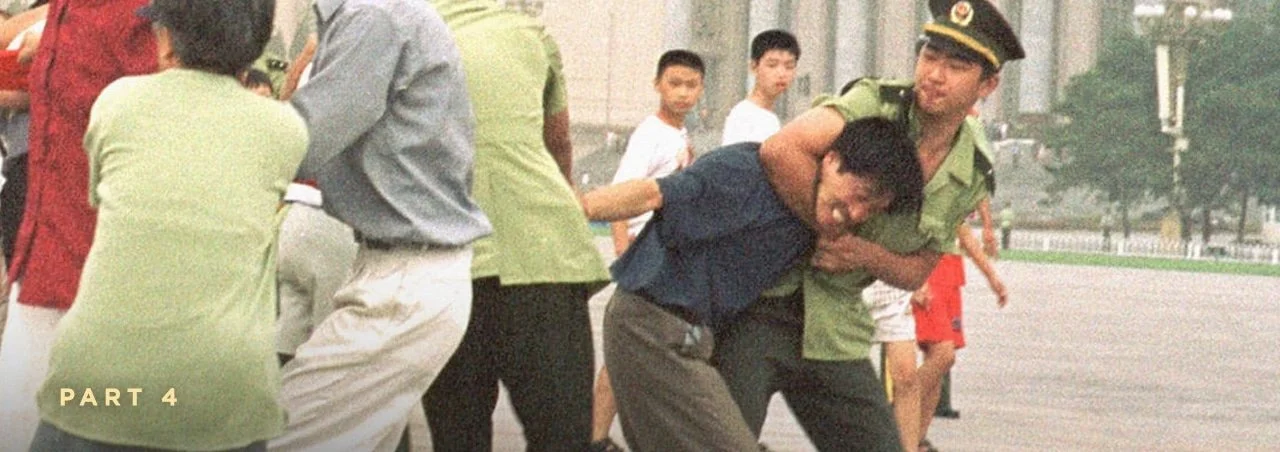
(Source: Falun Dafa Information Center)
The effects of such thinking extend beyond politics. When people are taught that their problems can be solved by defeating opponents, they naturally begin to look for the causes of problems outside themselves. Responsibility is assigned elsewhere, and someone else becomes the obstacle or the reason conditions are not as they should be. This mentality can be attractive because it offers comforting answers to complex problems. It tells us that it is someone else's fault. It is easier to identify an external enemy than to examine one's own shortcomings, and easier to demand change from others than to change oneself.
The logic of struggle also creates a justification for the use of force. If society is viewed as a battle between opposing groups, and if certain people are seen as obstacles to progress, then force can begin to appear not merely acceptable but necessary. Throughout history, communist movements have often defended censorship, imprisonment, political campaigns, violence, and even killing as essential steps toward a supposedly better future. The promised destination may differ from one regime to another, but the underlying reasoning remains similar: those who stand in the way must be overcome.
Falun Gong comes from A Different Starting Point
Falun Gong begins from a very different premise. Rather than encouraging people to focus on external enemies, the practice emphasises self-reflection and personal responsibility. Practitioners strive to align themselves with the principles of truthfulness, compassion, and forbearance. When conflicts arise, they are encouraged to ask what they themselves can improve rather than concentrating exclusively on the faults of others.
This does not mean ignoring injustice or pretending wrongdoing does not exist. Rather, it reflects the belief that lasting improvement begins with one's own conduct and character. When difficulties arise, practitioners are encouraged to step back, examine themselves, consider the perspectives of others, and ask themselves how they can respond in a better way.
Looking inward does not come naturally. Our first instinct is often to search for someone to blame, some institution to criticise, or some group responsible for our frustrations. Falun Gong asks practitioners to do something much more difficult: examine themselves first.
That simple shift in perspective can have profound consequences. A person who constantly focuses on the faults of others will experience the world differently from someone who regularly reflects on their own thoughts and actions. One approach tends to generate resentment and conflict. The other tends to cultivate humility and self-discipline.
Over time, such habits can shape not only individuals but also families, workplaces, and communities. Falun Gong does not offer a political programme or seek to transform society through the exercise of power. Instead, it teaches that genuine and lasting improvement begins with the individual. As a natural consequence, a better society emerges not from forcing others to change, but from individuals striving to improve themselves. Read: What My Australian Christian Upbringing Helped Me See About Falun Gong
Where Does Real Change Begin?
One of the defining assumptions of communism is that society can be improved primarily through changes to political and economic structures. If the system is transformed, a just and harmonious society is expected to emerge.However, the experience of communist societies in history suggests otherwise.
Many communist movements began with promises of equality, justice, and liberation. Yet once political power became concentrated, corruption followed. New elites emerged, and privileges developed. Ordinary citizens often found themselves subject to extensive censorship, surveillance, and political control.
This pattern appeared in different communist countries and under different leaders. The details varied, but the underlying problem remained remarkably consistent. Political power proved incapable of changing human nature itself.
Falun Gong approaches the issue from the opposite direction. Rather than assuming that a better society can be created through political and social control, it emphasises the importance of individual moral improvement. Honesty, kindness, patience, and integrity are not viewed as products of political reform but as qualities individuals must consciously develop.

(Courtesy of minghui.org)
The contrast highlights a deeper truth. No political system can create a healthy society if people remain selfish, dishonest, or consumed by the pursuit of power. By contrast, a society in which large numbers of people strive to become more honest, compassionate, and responsible is likely to flourish, regardless of its institutions.
Falun Gong does not offer a political blueprint. Instead, it focuses on the character of the individual. In doing so, it addresses something political ideologies often struggle to address: the moral choices people make every day when no law compels them and no authority is watching.
Why the CCP Feels Threatened
Seen in this light, the CCP's hostility towards Falun Gong becomes easier to understand. Authoritarian systems depend heavily on controlling information and shaping how people think. They encourage loyalty to the Party, acceptance of official narratives, and adherence to approved ideological frameworks. Independent religious and spiritual traditions can be viewed as competitors because they provide an alternative source of moral values and a different understanding of human life and purpose.
Falun Gong encourages practitioners to measure their behaviour against principles that exist outside political authority. It teaches people to value truthfulness even when telling the truth may be uncomfortable. It teaches compassion when bitterness might seem justified. It teaches forbearance when retaliation appears tempting. Most importantly, it encourages people to improve themselves rather than participate in campaigns of struggle against others.
From the perspective of the CCP, Falun Gong represents more than a spiritual practice. It embodies a fundamentally different understanding of human nature and social change. The Party's worldview places great faith in ideology, political power, and the ability to reshape society from above. Falun Gong begins somewhere else. It emphasises conscience, personal responsibility, and the belief that lasting improvement starts with the individual.
This philosophical divide helps explain why the persecution has persisted for so many years. The CCP is not simply opposing a meditation practice. It is confronting a worldview that challenges some of its most fundamental assumptions about power, morality, and social progress.
Whatever one thinks of Falun Gong, the contrast is striking. One philosophy teaches that progress comes through struggle against others. The other suggests that genuine progress begins when individuals strive to become more truthful, compassionate, and tolerant themselves.
The difference extends to the question of force itself. Political systems can compel obedience, enforce laws, and punish dissent, but they cannot force people to become genuinely honest, compassionate, or patient. Those qualities must be chosen.
Perhaps that is why the conflict between the CCP and Falun Gong has never been merely political. At its core lies a disagreement over where genuine change begins: with the exercise of power, or with the improvement of the human heart.
~~
‘Learn Falun Gong—Australia & New Zealand’ is a website run by Australian and New Zealand Falun Dafa volunteers for the benefit of the general public. Falun Dafa is always taught free of charge.
Falun Dafa volunteers are currently holding free online classes where you can learn the exercises from the comfort of your own home. Register for a free Falun Dafa online exercise class here or for the Falun Dafa 9-Day Lecture Series here.
Views expressed in this article represent the author's own opinions or understandings.