
What Is the 610 Office? The Agency Behind the Persecution of Falun Gong
When people think about the persecution of Falun Gong in China, they might picture police raids, prisons, labour camps, relentless propaganda, and reports of forced organ harvesting. Less well known is the organisation that helped coordinate much of it.
Known simply as the "610 Office" (pronounced "six-ten"), it operated for years as a powerful body tasked with directing the campaign to eradicate Falun Gong.
Although relatively unknown outside China, the 610 Office played a central role in one of the largest campaigns against a spiritual group in modern history. Understanding the persecution of Falun Gong is difficult without understanding the organisation created to direct it.
Why Was the 610 Office Created?
Falun Gong emerged in China in 1992 and quickly became popular. Combining meditation exercises with moral teachings centred on truthfulness, compassion, and forbearance, the practice attracted people from all walks of life. By the late 1990s, Chinese government estimates suggested that tens of millions of people had taken up the practice.
Not everyone within the Chinese leadership viewed this growth with alarm. However, then-Communist Party leader Jiang Zemin came to regard Falun Gong's rapid growth, its traditional spiritual and moral teachings, and its independence from Communist Party control as a challenge to the Party's ideological authority. In early June 1999, before any formal ban had been announced, Jiang instructed senior officials to prepare for a nationwide campaign against the practice.
On 10 June 1999, several weeks before the public launch of the persecution, the Party established a special body to deal with what it called the "Falun Gong problem." Because it was created on June 10, the organisation became known as the "610 Office." It was created specifically to direct and coordinate the campaign against Falun Gong.

(courtesy of the Falun Dafa Information Center)
An Organisation Outside the Legal System
Unlike a normal government agency, the 610 Office was not created through legislation. It was established by internal Communist Party directives and operated outside China's ordinary legal framework.
Researchers and human rights organisations have frequently described the 610 Office as an extralegal body. Established by internal Communist Party directives rather than legislation, it existed outside China's formal legal framework, yet possessed authority that reached across numerous institutions.
Through a network of branches throughout the country, it coordinated with police departments, courts, prosecutors, schools, workplaces, neighbourhood committees, media organisations, and local governments to implement Party policy toward Falun Gong.
Some observers have compared it to a political task force with powers that extended beyond normal legal institutions. Whatever label one chooses, its existence illustrated an important reality of China's political system: when the Communist Party identifies something as a threat, Party authority can override ordinary legal procedures.
Coordinating a Nationwide Campaign
Suppressing tens of millions of practitioners across a country the size of China required far more than police action. It required coordination. The 610 Office became the mechanism through which that coordination took place. It worked alongside propaganda authorities, public security organs, judicial bodies, and local officials to ensure that the campaign was implemented nationwide.
State media launched a relentless propaganda campaign portraying Falun Gong practitioners as dangerous and irrational. The campaign relied heavily on sensational allegations and highly publicised incidents that critics argued were misleading or fabricated. As the body responsible for coordinating the persecution, the 610 Office played a central role in organising the broader propaganda effort alongside police, media organisations, and other Party institutions. Schools, universities, and workplaces organised mandatory sessions denouncing the practice. In some areas, local officials were reportedly given quotas and targets.
Individuals who refused to renounce their beliefs could be subjected to detention, imprisonment, forced labour, or various forms of ideological "transformation". Lawyers and researchers have documented allegations of torture and abuse in detention facilities, while human rights groups have argued that the campaign relied heavily on coercion and political pressure rather than normal legal procedures.
Over the years, independent investigators, human rights organisations, and expert tribunals have also examined allegations that imprisoned Falun Gong practitioners were killed for their organs to supply China's transplant industry.
Critics contend that the persecution created a large population of detainees outside normal legal protections, making such abuses possible. The findings of the China Tribunal and numerous researchers have concluded that forced organ harvesting from prisoners of conscience has occurred on a substantial scale, with Falun Gong practitioners believed to have been among the principal victims.
Although no public documents have emerged linking the 610 Office directly to organ procurement, the scale and duration of forced organ harvesting described by investigators and expert tribunals have led many observers to conclude that such a system would have been impossible to carry out without the knowledge or cooperation of the Party-security apparatus responsible for the persecution of Falun Gong. As the organisation established to coordinate that campaign, questions inevitably arise about how much the 610 Office knew and what role it may have played.
Transformation Through Re-Education
Perhaps the most distinctive aspect of the campaign was its emphasis on what Chinese authorities called "transformation". The objective was not merely to detain Falun Gong practitioners, but to compel them to renounce their beliefs and demonstrate loyalty to the Communist Party.
The 610 Office played a key role in coordinating and driving these efforts. Across China, practitioners were sent to detention centres, labour camps, prisons, and specialised "legal education" or "transformation" centres. Officials were often given quotas and faced pressure to achieve high rates of ideological conversion.
Methods varied from place to place. Former detainees, lawyers, and human rights organisations have described intense psychological pressure, sleep deprivation, constant propaganda sessions, forced denunciations, and, in some cases, physical abuse. Individuals who signed statements renouncing Falun Gong were sometimes required to criticise the practice publicly or persuade others to abandon it as well.
Researchers have noted that the emphasis on ideological transformation reflected a longstanding Communist Party tradition dating back to Mao-era political campaigns. The purpose was not simply to punish dissent, but to reshape thought itself. Success was measured not only by obedience but also by outward demonstrations of ideological conformity.
For many practitioners, refusing to sign such statements resulted in prolonged detention or harsher treatment. Human rights groups have argued that the campaign represented an attempt to eradicate Falun Gong as a belief system and social community.
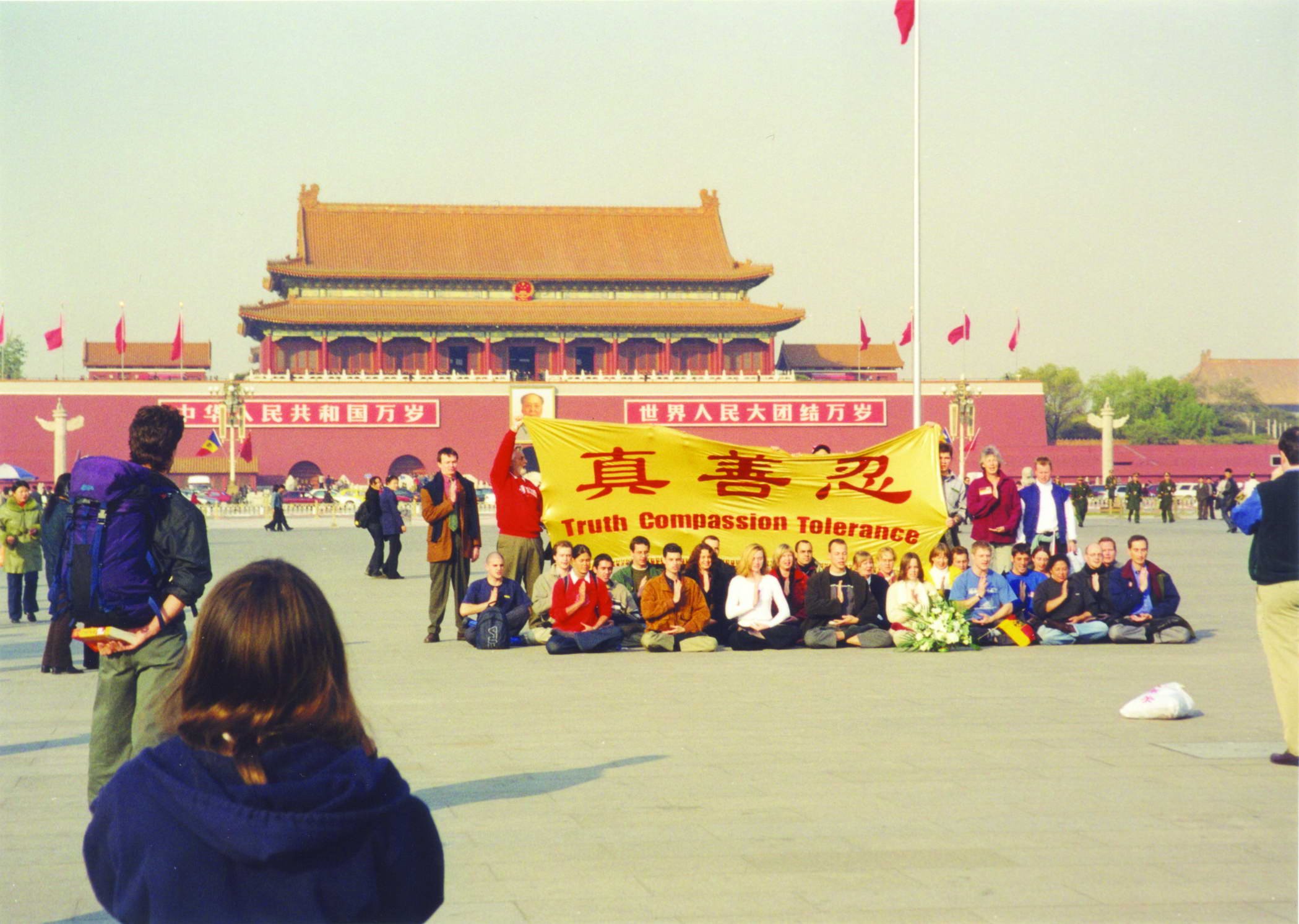
36 westerners from around the world suddenly appeared at Tiananmen Square in Beijing with a message that astounded onlookers in China and around the world. (courtesy of minghui.org)
A System Above the Courts
One of the most unusual features of the 610 Office was its ability to influence institutions that, at least in theory, were supposed to function independently. Police, prosecutors, judges, prison authorities, and local governments were expected to implement Party directives concerning Falun Gong, with the 610 Office playing an important coordinating role. As a result, decisions concerning detention and sentencing were often shaped by political priorities rather than by judicial processes.
Critics argued that the campaign exposed the extent to which China's legal institutions remained subordinate to Communist Party authority, with political priorities taking precedence over legal protections whenever the Party deemed it necessary.
Was the 610 Office Abolished?
In 2018, Beijing announced that the 610 Office had been dissolved as part of a broader restructuring of Party and state institutions. Its functions were reportedly absorbed by other bodies, including the Political and Legal Affairs Commission and the Ministry of Public Security.
Some observers viewed the announcement as the end of the organisation. Others argued that it represented more of an administrative reorganisation than a genuine dismantling. They noted that campaigns against Falun Gong practitioners continued and that many of the functions previously associated with the 610 Office appeared to have been absorbed into other Party and security bodies.
Critics have also dissented but questioned whether the move represented a substantive change or simply a restructuring that made the organisation itself less visible.
Why the 610 Office Matters
The 610 Office was more than just another government department. It was a specialised organisation created to carry out a political campaign against a spiritual practice. Its existence demonstrated how the Chinese Communist Party could establish institutions outside the normal legal framework whenever it deemed an issue important enough.
For more than two decades, millions of practitioners and their families have felt the consequences of decisions made by an organisation that many people around the world have never heard of. Yet understanding the persecution of Falun Gong requires understanding the 610 Office.
It was the central mechanism that transformed a political decision made at the highest levels of the Party into a nationwide campaign affecting millions of lives. Although the 610 Office itself was formally dissolved, the persecution it helped coordinate has never ended.
Although still little known outside China, the legacy of the 610 Office continues to raise uncomfortable questions about the relationship between political power, legal institutions, and freedom of belief.
~~
‘Learn Falun Gong—Australia & New Zealand’ is a website run by Australian and New Zealand Falun Dafa volunteers for the benefit of the general public. Falun Dafa is always taught free of charge.
Falun Dafa volunteers are currently holding free online classes where you can learn the exercises from the comfort of your own home. Register for a free Falun Dafa online exercise class here or for the Falun Dafa 9-Day Lecture Series here.
Views expressed in this article represent the author's own opinions or understandings.