
Is Falun Gong Really a ‘Cult’ or not? Here’s A Closer Look at the Facts
Few modern spiritual movements have been as persistently mischaracterised as Falun Gong. Since its introduction to the public in China in the early 1990s, it has attracted tens of millions of practitioners across the world.
Yet, despite its peaceful teachings and demonstrably positive effects on adherents, it has been repeatedly labelled a “cult”—a term that carries strong negative connotations but little precise meaning.
When examined carefully, this label does not hold up. Instead, the evidence strongly suggests that Falun Gong is a beneficial spiritual practice that has been unfairly stigmatised, particularly through a sustained campaign by the Chinese Communist Party (CCP).
In modern discourse, the term “cult” has become a loaded and often weaponised term. It is commonly used to imply manipulation, coercion, and harm, regardless of whether those characteristics are actually present.
Because of this, many scholars prefer the term “new religious movement” when analysing groups like Falun Gong. The continued use of “cult” in public narratives often reflects social bias, fear of the unfamiliar, or—importantly in this case—political motivation. [Read Is Falun Gong Weird? I tried it, and here’s what happened]
What Falun Gong Actually Is
Falun Gong, also known as Falun Dafa, is a spiritual discipline that combines slow, meditative exercises with a moral philosophy centred on three principles: truthfulness, compassion, and forbearance. These values are not only non-controversial, but widely regarded as universally beneficial.
The practice itself is simple and accessible. Practitioners perform gentle qigong exercises and meditation, and they study teachings that encourage self-improvement and ethical behaviour. There is no formal membership system, no hierarchy of authority enforcing compliance, and no requirement for financial contributions. People are free to begin practicing, to practice casually, or to stop altogether without any penalty or social pressure.
This openness and voluntariness stand in direct contradiction to the defining features commonly associated with harmful cults. There is no evidence of systematic control over members’ personal lives, no enforced isolation from society, and no mechanisms of exploitation. On the contrary, Falun Gong encourages individuals to remain engaged with their families, careers, and communities while improving themselves morally and physically. [Read: 5 Reasons Why Falun Dafa is Great!]

A woman practices the 5th Falun Dafa exercise, a sitting meditation.
Why the ‘Cult’ Narrative Emerged
The persistence of the “cult” label is closely tied to political developments in China rather than to the nature of Falun Gong itself. By the late 1990s, Falun Gong had grown extraordinarily popular, with estimates suggesting between 70 million to 100 million practitioners. This rapid growth occurred independently of state structures, which made the movement unusual in a country where organised activity is typically subject to government oversight.
In 1999, the CCP formally banned Falun Gong and initiated a nationwide campaign to eradicate it. Central to this effort was a propaganda strategy that portrayed the practice as dangerous, irrational, and socially destabilising. The label “cult” became a key component of this narrative, repeated across state-controlled media to shape public perception and justify repression.
This context is critical. When a government with strict controls over information systematically promotes a particular characterisation of a group it seeks to eliminate, that characterisation must be approached with caution. Independent observers and international organisations have repeatedly noted discrepancies between state claims and verifiable evidence regarding Falun Gong. For example, Amnesty International has documented arbitrary detention and politically motivated prosecutions, while also criticising official reports for omitting ongoing persecution. Similarly, Human Rights Watch has reported widespread arbitrary detention of practitioners exercising peaceful beliefs.
A crucial but sometimes underemphasised factor in understanding the persecution of Falun Gong is the role of then–Communist Party leader Jiang Zemin. Historical accounts and internal analyses (see this academic overview) indicate that the campaign against Falun Gong was not the result of a broad consensus within the Chinese leadership, but was instead driven largely by Jiang’s personal directive. Concerned about the movement’s size, independence, and ideological influence, Jiang reportedly pushed for decisive action even when other officials viewed Falun Gong as largely benign.
In June 1999, Jiang oversaw the creation of the “610 Office,” an extra-legal security apparatus specifically tasked with eliminating Falun Gong. This body operated outside the normal legal framework and coordinated propaganda, surveillance, and detention efforts nationwide. The centralisation and intensity of the crackdown reflected a top-down initiative, underscoring that the persecution was not a spontaneous public response to a harmful group, but a politically driven campaign initiated at the highest level of power.
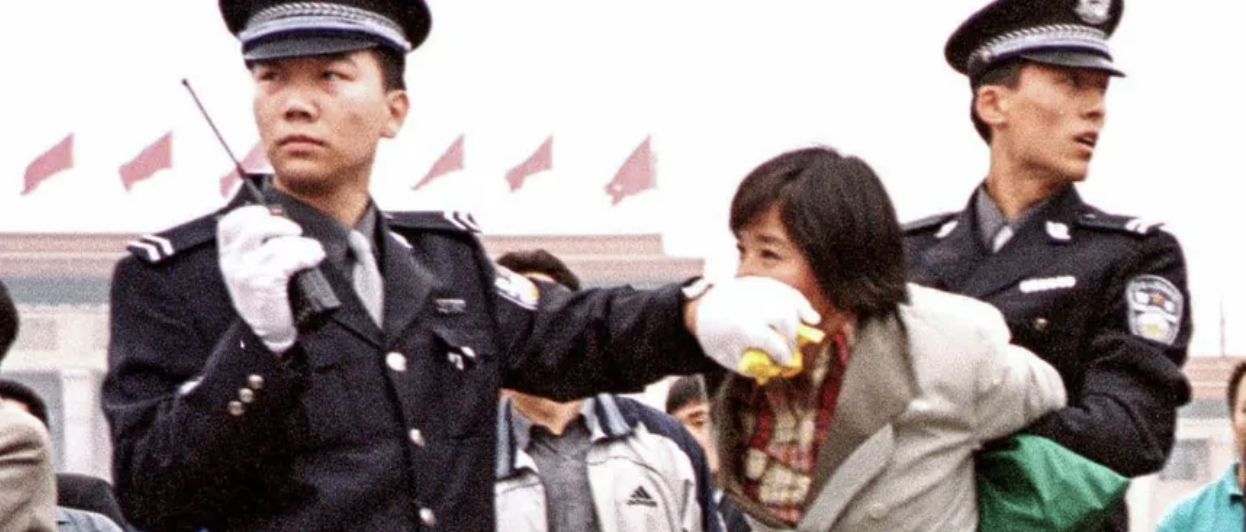
A Falun Dafa practitioner is arrested and silenced by Chinese policemen under the direction of the CCP (Chinese Communist Party)
Documented Persecution by the Chinese Communist Party
The campaign against Falun Gong has been widely documented and remains one of the most significant human rights concerns of the past two decades. Practitioners in China have been subjected to a range of severe and well-substantiated abuses.
Reports from organisations such as Amnesty International and Human Rights Watch describe widespread arbitrary detention of Falun Gong practitioners, often without trial. Many have been sent to labour camps, detention centres, or prisons solely for practicing their beliefs or distributing informational materials.
There is also substantial evidence of torture and mistreatment in custody. Former detainees have reported beatings, sleep deprivation, forced stress positions, electric shock torture, and psychological coercion aimed at forcing them to renounce their beliefs. These accounts have been consistent across numerous independent testimonies over many years.
Particularly alarming are credible allegations of forced organ harvesting. Investigations by independent tribunals and researchers—including the China Tribunal in London—have concluded that prisoners of conscience, including Falun Gong practitioners, have been killed for their organs on a significant scale in China. While the full extent of these practices remains difficult to verify due to restrictions on access, the volume and consistency of evidence have led many experts to regard these allegations as highly credible.
In addition to physical repression, the CCP has carried out extensive efforts to suppress Falun Gong’s presence in the public sphere. This includes censorship, surveillance, and pressure on individuals and organisations abroad to distance themselves from the movement. Together, these actions form a comprehensive campaign not only to control behaviour, but to shape global perception.
The Lived Reality of Practitioners
Outside China, where individuals are free to practice without fear of persecution, the lived experiences of Falun Gong practitioners provide a powerful counterpoint to the “cult” narrative. Across different countries and cultures, practitioners consistently describe the practice in positive terms.
Many report improvements in physical health, including increased energy, reduced stress, and relief from chronic conditions. While such experiences vary from person to person, they are widely and repeatedly attested.
Equally significant are the psychological and moral benefits. Practitioners often emphasise how the principles of truthfulness, compassion, and forbearance influence their daily lives. These values encourage patience in difficult situations, kindness toward others, and a commitment to personal integrity.
Rather than withdrawing from society, practitioners frequently become more engaged with it. Falun Gong communities organise public exercise sessions, cultural events, and volunteer activities. They also participate in peaceful advocacy efforts, particularly to raise awareness about human rights issues in China. This outward-facing orientation reflects a sense of responsibility toward others, not isolation from them.
Evaluating Falun Gong Against Common ‘Cult’ Criteria
When assessed against widely recognised characteristics of harmful cults, Falun Gong does not fit the profile. There is no authoritarian leader exercising direct control over members’ daily lives, no formal restrictions on leaving the practice or interacting with outsiders, and no clear evidence of systematic financial or personal exploitation. [Read: My Experience Practicing Falun Dafa, And My Thoughts About The Leader Of Falun Gong]
At the same time, it is important to acknowledge that some former practitioners have publicly criticised Falun Gong and described it in negative terms, including as a “cult.” Such perspectives reflect individual experiences and disagreements, which are not uncommon in the context of spiritual movements and religions more broadly. Across many traditions, individuals choose to leave for a variety of personal, ideological, or social reasons, and these departures do not in themselves constitute evidence of coercion or harm.
Falun Gong is characterised by voluntary participation, minimal organisational structure, and an emphasis on individual moral development. Its teachings are publicly available, allowing individuals to examine them independently and decide whether to engage in the practice. Practitioners are free to discontinue at any time. Moreover, the central text, Zhuan Falun, suggests that even those who do not continue practicing may still gain insight into moral principles and benefit society, reinforcing the notion that participation is not framed as exclusive or compulsory.
It is also important to note that many mainstream religions and widely accepted practices could, under overly broad definitions, be labelled as “cults.” This further underscores the limitations of the term as a precise analytical category.
A More Accurate Understanding of Falun Gong
Taken together, the evidence points to a clear conclusion: Falun Gong is not a harmful cult, but a peaceful spiritual practice that has been systematically misrepresented. Its core teachings promote values that are widely regarded as positive, and its structure allows for freedom, flexibility, and personal choice.
The negative portrayal of Falun Gong is best understood not as an objective assessment, but as the result of a sustained and politically motivated campaign. This does not mean that all criticism should be dismissed outright, but it does mean that such criticism must be evaluated carefully and in context.
Conclusion
The question of whether Falun Gong is a “cult” can be answered with increasing clarity: it is not. The label fails both on definitional grounds and in light of the available evidence. More importantly, it obscures a reality that is far more constructive and humane.
For millions of practitioners, Falun Gong has provided a path to better health, greater emotional balance, and a stronger moral compass. Its emphasis on truthfulness, compassion, and forbearance fosters not only personal growth, but also positive contributions to society.
At the same time, the severe persecution faced by practitioners in China stands as a stark reminder of how language can be used to justify injustice. Recognising the true nature of Falun Gong is therefore not only a matter of intellectual accuracy, but also of basic fairness.
In reassessing this movement, it becomes clear that Falun Gong deserves to be understood on its own terms—not through the lens of a misleading label, but through the tangible benefits it brings to individuals and the resilience it has demonstrated in the face of extraordinary adversity.
~~
We hope you enjoyed reading this post.
Falun Dafa volunteers are currently holding free online classes where you can learn the exercises from the comfort of your own home. Register for a free Falun Dafa online exercise class here or for the Falun Dafa 9-Day Lecture Series here.
‘Learn Falun Gong—Australia’ is a website run by Australian Falun Dafa volunteers for the benefit of the general public. Falun Dafa is always taught free of charge.
Views expressed in this article represent the author’s own opinions or understandings.